
In 2020, Austin, Texas-based behavioral health provider Integral Care achieved a rare success: When dispatchers in the Austin 9-1-1 call center answered the phone, callers were asked what type of emergency assistance they were seeking – police, fire, EMS … or mental health. The inclusion of mental health as a standalone emergency service marked a new phase in Travis County’s approach to public health and safety, recognizing mental health crisis responders as an equal partner able to deliver unique skills and services that traditional emergency responders couldn’t.
While the inclusion of Integral Care crisis response teams in the 9-1-1 emergency response system was a major step in ensuring that persons experiencing mental health crises were attended to by the most qualified responders, integrating their teams into the 9-1-1 workflow had its own challenges.
Last month at the Alternative Mobile Service Association’s (AMSA) annual convening in Chicago, IL, we had the chance to chat with Kedra Priest, Practice Administrator of Crisis Services at Integral Care, and learn more about the technical challenges they faced integrating with 9-1-1 and how they’re using the Beacon Crisis Response platform to ensure seamless coordination with 15 different law enforcement agencies and EMS providers across Travis County.
Mobile Crisis and 9-1-1: System Design and Operations
“Integral Care manages three types of mobile crisis outreach teams: First, there’s our traditional MCOT team, which is dispatched out by our crisis helpline and calls from 988. Then we have another team called EMCOT, the expanded mobile crisis outreach team. They function similarly to MCOT, however, they’re dispatched by our first responder partners, so when a call filters through 911 and first responders respond, they’re able request a mobile crisis clinician to the scene for mental health support through their respective dispatchers. Finally, we have what we call the C3 team, which functions similarly to our crisis helpline, but in this case we have clinicians embedded in the 9-1-1 call center, so when calls come in where a primary mental health need is identified, those calls can transfer to our clinicians who take over the call, and then they can also dispatch EMCOTs in the community to respond for a face-to-face visit.
Challenges of Integration with 9-1-1
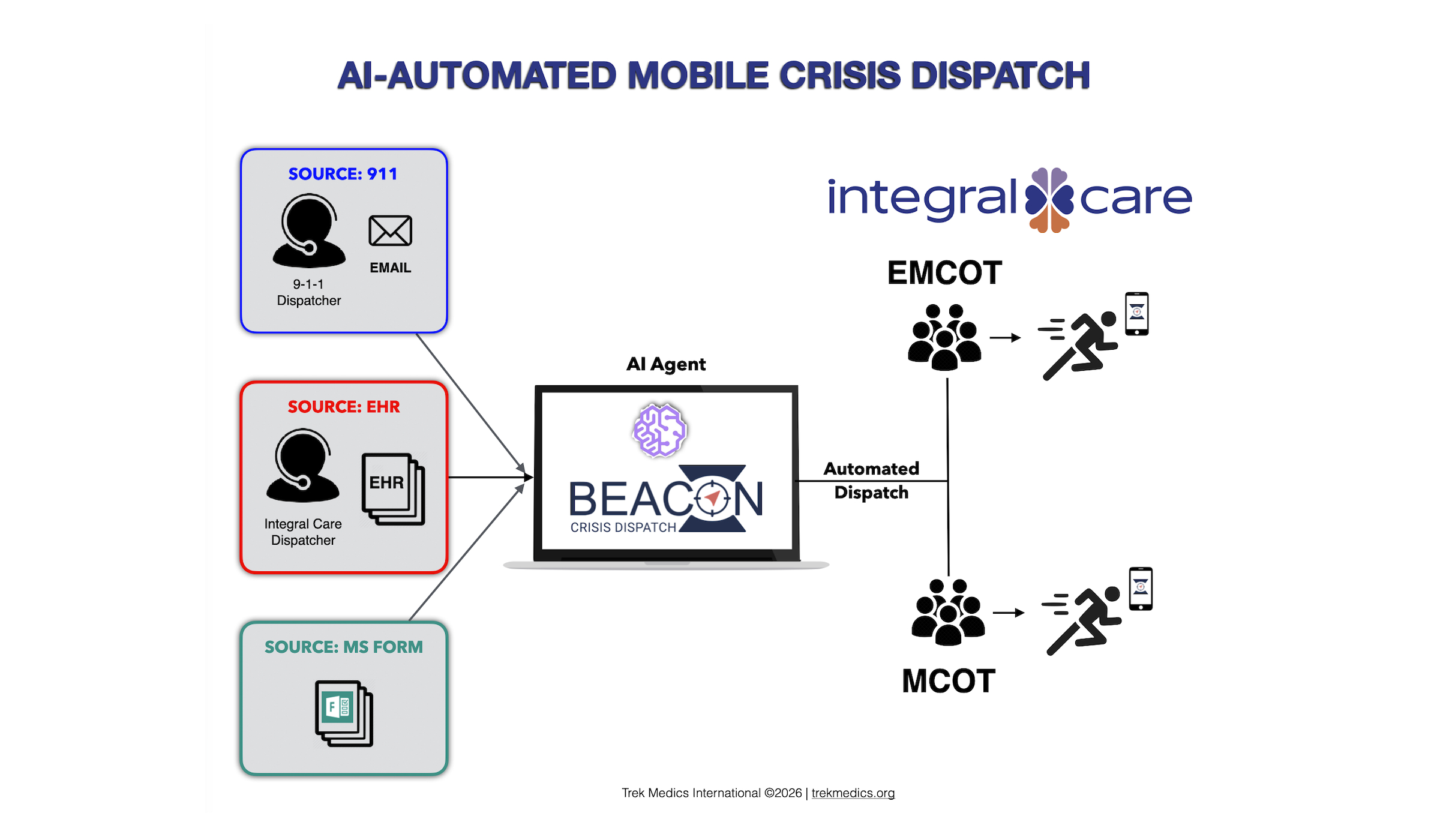
“When I say cases were dispatched by our crisis line, 9-1-1, or our C3 clinicians, I’m using the term loosely because the process wasn’t centralized. In reality, dispatch was happening through several different channels at once. For MCOT, dispatches primarily came through emails routed from our electronic health record. Once a call was assigned, the MCOT hotline staff used Microsoft Teams to communicate with clinicians, checking who was available, confirming when they arrived on scene, requesting updates, and tracking the status of the call. EMCOT operated differently. Our law enforcement and EMS partners sent incidents through pagers with the incident number, address, and phone number. We would then call the 9-1-1 dispatcher back to provide our estimated time of arrival while simultaneously communicating with our clinicians through Microsoft Teams. Clinicians were expected to update the chat when they were responding, arrived on scene, transporting a patient, and when they cleared the call. Because information was spread across emails, pagers, phone calls, and Teams chats, it was challenging to maintain situational awareness. On a daily basis, staff were searching through messages to determine where clinicians were, how long they’d been on scene, and who was available. We essentially needed one person dedicated to monitoring chats, pages, and emails just to keep track of team status. Given the volume of calls, that was a significant operational burden. It also consumed time that could have been spent providing supervisory support and ensuring clinician safety. To make matters more challenging, clinicians had to manually document every milestone for each call in a notebook, including when they received the dispatch, arrived on scene, departed the scene, began transporting, and cleared the call. Tracking all of those timestamps manually created additional work and increased the risk of missed or inaccurate documentation.
“The other big problem was that because we were getting requests for assistance from 15 different entities via emails, pages, or even phone calls when we were needed – with each entity providing different levels of information in different formats — we would have to keep lists of all the requests to ensure that we were getting to all of them because they would come in at varying urgency levels. So some of those we would respond to immediately, but for the others we would need the clinician to clear the scene before they could accept the next dispatch. And as we’ve been scaling our services to meet the increased demand for our teams, it just got to be too much – and why we decided to adopt Beacon.
How Beacon Uses AI to Link 9-1-1 with Mobile Crisis Outreach Teams
“The beauty of Beacon has been that it’s able to take all the information that we were receiving and automate the dispatching, so we’re able to really reduce that overhead of monitoring. Now, our supervisors can just look at a map and see where everyone is. Our clinicians are able to still accept the requests for assistance and assign themselves, or we can also have supervisors assign them to incidents, so they know which incident they’re going to next. It’s just been really great to have it all streamlined: Our supervisors are freed to do other tasks and it makes it easier for the clinicians too, because they can open up the app and see where the incident is. They don’t have to type in the address in their GPS system, or text the team that they’re responding, and instead they can now communicate all of that just by the touch of a button, which has been really great and well received by our teams.
“The most innovative part of what Beacon is doing for us is how it’s streamlined the process of receiving requests for assistance from the 15 different law enforcement agencies and EMS providers. Instead of receiving them through pages, emails, phone calls, the entities are sending them all to Beacon as an email, which is then using AI to open the emails, extract the incident location, the details, the priority, and then Beacon automatically dispatches the incident out to the most appropriate team.
Change Management
“Getting all of our partner agencies to switch to this process has actually gone pretty smoothly. We have a few here and there that’ll forget to send the requests by email, and so we’re sending them reminders, but the switch has been a lot easier than I thought it would be. And for our clinicians who are embedded in the 9-1-1 call center, they don’t actually have access to any of the CADs our partners are using, so now with Beacon they’re able to see where our clinicians are and can provide updates to them when responding to incidents coming out of the 911 call center, which I think has been an added benefit that we didn’t really know we were going to have. There’s even potential for further integration between the different 9-1-1 CADs and Beacon that we’re really excited about, and I don’t even think we know yet all the ways we’re going to utilize Beacon in the future — but for now it’s been great. Beacon has automated the dispatch process, it collects all the timestamps and incident details for our clinicians, and it means we’re not having to worry about hiring 24-7 dispatchers to manage everything as we continue to scale. For example, we’re about to add a YCOT team now, too – a youth crisis outreach team – and that’s going to put us at about 60 clinicians that we’ll have to coordinate 24-7. With the old way, it would’ve just been too much. Now, we don’t have any worries about scaling our services.
How Beacon Enhances Data Analytics
“The other exciting thing with Beacon that we didn’t expect to happen is that our application support team has been able to tap into the Beacon data to pull out data and put them in our existing dashboards so our managers can monitor a lot of these data points that we report out on, in near-real-time. Then the next step is to get rid of the internal assessment documentation we keep and integrate it within Beacon, so we can then just pull that data directly out of Beacon, too, which means even less work for our clinicians.”
This partnership was made possible in part through support from the Patrick J. McGovern Foundation.
To learn more about Integral Care’s Mobile Crisis Outreach program, contact Kedra Priest, Practice Administrator of Crisis Services, at: https://integralcare.org/en/contact/
To learn more about the Beacon Crisis Dispatch platform, contact us at: [email protected]